Upcoming Events
Don't miss out on upcoming events! Click here to learn more and register.
__largepreview__.webp)
Summary
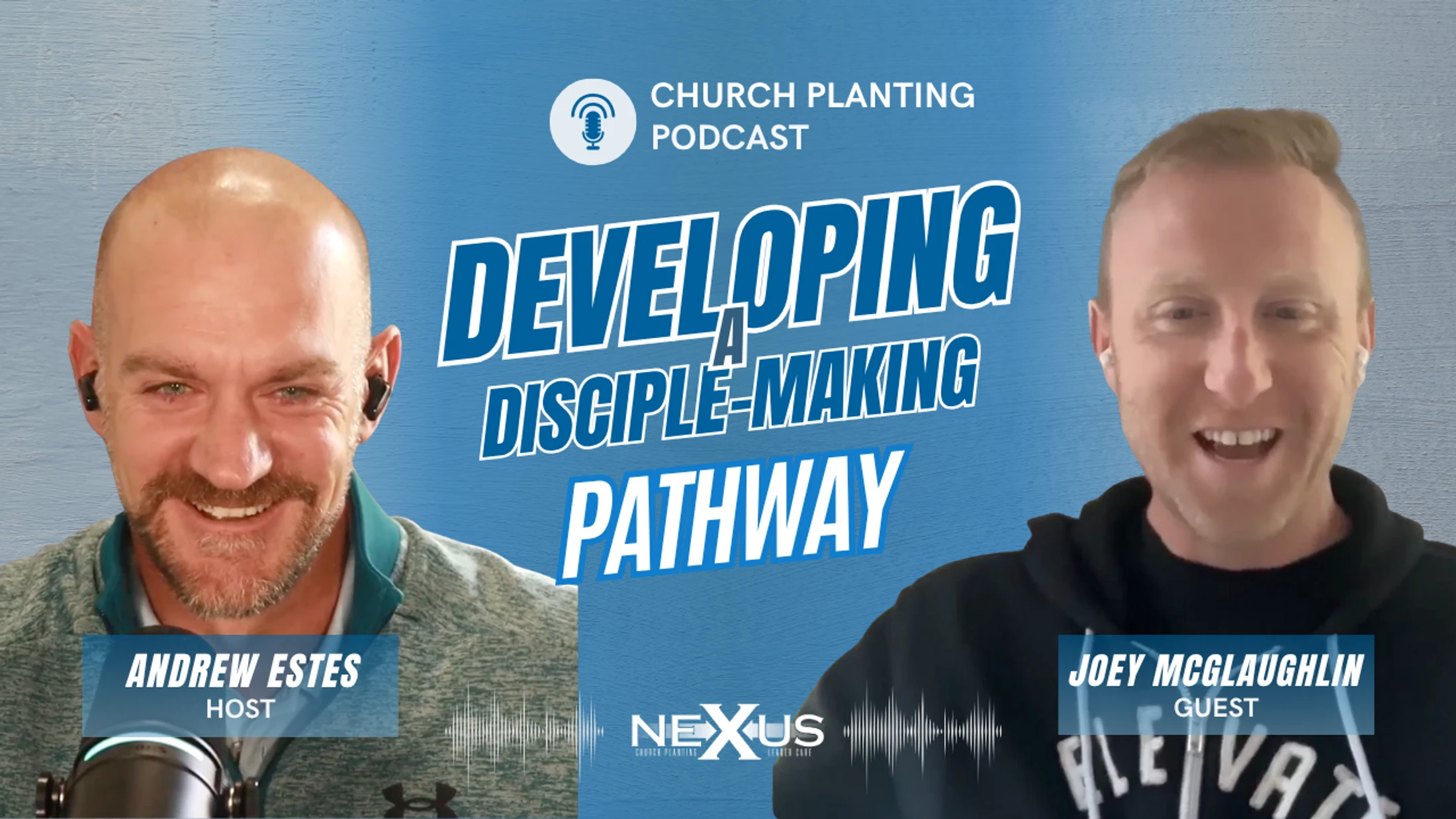
In this episode of the Nexus Church Planting Podcast, host Andrew Estes welcomes Joey McLaughlin, lead founding pastor of Elevate City Church in Atlanta, Georgia. They discuss the integration of discipleship into church DNA, the challenges of church planting, and the innovative Equip and EquipX programs designed to create deeply rooted disciple makers. Joey shares his personal journey and insights on multiplying leaders across generations while maintaining the importance of Sunday gatherings.
Takeaways
- Discipleship should be at the core of church activities, not just a component.
- Equip and EquipX programs are designed to create deeply rooted disciple makers.
- Sunday gatherings serve as a centering point for teaching and celebration.
- Church planting involves embracing challenges and learning from them.
- Multiplicative disciple making requires intentionality and relational investment.
- EquipX is a year-long spiritual formation journey.
- The mission is multiplication, and everyone is encouraged to lead.
- Discipleship involves both learning and teaching others.
- Movement is messy, but it's essential for growth.
- Sunday gatherings are likened to a locker room for strategy and celebration.
Sound bites
"Discipleship is our crown."
"EquipX is a year-long journey."
"Sunday is the locker room."
"Movement is messy."
"The mission is multiplication."
"Equip is the tip of the spear."
"Discipleship must be relational."
"Sunday gatherings are for celebration." "
EquipX transforms disciple makers."
"Church planting is a learning journey."
Chapters
00:00:00 Introduction and Welcome
00:00:00 Joey's Church Planting Journey
00:00:00 The Equip and EquipX Programs
00:00:01 Integrating Discipleship into Church DNA
00:00:01 The Role of Sunday Gatherings
00:00:02 Challenges and Insights in Church Planting
00:00:02 Conclusion and Resources
Keywords
church planting, discipleship, Equip program, Elevate City Church, Joey McLaughlin, Andrew Estes, Nexus Podcast, leadership, Sunday gatherings, disciple making
Andrew Estes (00:09)
Well, welcome to the Nexus Church Planting Podcast. We're here to help equip pastors and leaders to multiply disciple-making communities. I'm your host, Andrew Estes, and today I'm excited to welcome my new friend, Joey McLaughlin, the lead founding pastor of Elevate City Church in Atlanta, Georgia. I heard Joey first speak at the discipleship.org conference earlier this year and talking about First Thessalonians 2.19 and
just really, really powerful stuff as he talked about and asked the question, if disciples are supposed to be our crown, does your calendar actually reflect your crown? Joey brings a powerful conviction that the church is only as good as its disciples and that effective disciple making must be multiplicative, relational, and rooted in the local church. At Elevate, Joey has led the development of Equip
a 20-week disciple-making journey disguised as a 10-week disciple-making journey, and EquipX, which is a one-year formation pathway designed to create deeply rooted disciple makers, which is just some phenomenal content. And I'm excited to kind of talk through some of that. But what makes Elevate's model really especially compelling is that their integration with this disciple-making movement model without abandoning the power of the Sunday morning gathering.
So today we're going to explore how that integration works, how they've embedded discipleship into their DNA of their church, multiplied leaders across generations and kept Sunday as a meaningful launch pad for deeper formation. Joey, thank you so much for being here, man. Welcome to the podcast.
Joey McLaughlin (01:48)
Andrew, thanks for having me man. Pumped to hang out.
Andrew Estes (01:50)
Awesome, dude. Well, yeah, I'd love to hear and just kind of start out and just hear, especially since we're a church planting podcast, you know, just kind of walking through maybe your church planting journey of what that's actually looked like at Elevate. So once you take us back a little bit as to what that journey was like for you.
Joey McLaughlin (02:05)
Yeah, well, first off, your introduction makes it sound like I'm way too cool. And like we've done way more than I think that we actually have. So super honored to be on here. Happy to help in any way that we can. Bro, the truth is, is that we are nitty gritty practitioners who are in the thick of everyday pastoring, church planning, leading, interacting with people. Man, my hands are still dirty with just the real work of ministry, broken people and broken lives and...
doubts and questions and marital problems and trying to raise kids and trying to express the gospel in our city in a way that actually sees heaven begin to come to earth. So, I'm honored to be a part of this. My church planning journey, so maybe a little high level of my ministry journey. I grew up in a pretty broken home. ⁓ Parents got divorced when I was young. Mom went through several string of marriages. My dad encountered Jesus. ⁓
He was very, like on a track to want to be a very successful guy. He wanted to build the tallest skyscraper in downtown Atlanta. And ⁓ he was just angry, short-tempered, met Jesus, radical encounter. I often say one of the greatest apologetics in my life early on was just the undeniable encounter that I saw my dad. These vivid memories of my dad taking a wallet and throwing it against like a wall and credit cards flying everywhere.
It's just like a, like the synopsis of who my dad was in my, in my early years, but he met Jesus and overnight he becomes tender and affectionate and present. And he's teaching us about this person, Jesus. And I remember eight or nine years old wanting to know the Jesus that my dad knew. And so yeah, very early on, had a genuine affection for the Lord, not necessarily a straight line, you know, ⁓ you get to high school and you question things and you, ⁓ sow to the flesh and reap a ton of destruction. But.
I experienced discipleship in high school and this guy named Ryan came alongside me and he invited me into his world and his life and he taught me how to open up the Bible and he asked me really hard questions and held me accountable and also did like crazy stuff with me like would take me to play ding-dong ditch which I don't know how that fits in the world of like I'm teaching you how to follow Jesus but now we're gonna go and knock on people's doors and run away in the middle of the night so
But for me and my kind of personality, I think that there was something about that that was so intriguing. I always say that what Ryan did is he made John 10 10 so real in my life that the enemy comes to steal, kill, and destroy, but Jesus came that you might have life and have it more abundantly. Ryan showed me that ⁓ it wasn't, you know, I didn't have to choose. Okay, was I going to follow Jesus and live a boring life or was I going you know, live for the things of the world and have an exciting life?
He said, there's so much more life and adventure to be found in Jesus. So that was so formative for me ⁓ of just being saturated in deep relational discipleship where someone opened up their whole world and, know, he's probably four or five years older than I was. And he played college basketball. And so that was intriguing to me because that's the journey that I was on. And yeah, he just opened up his world and he didn't have all the answers, but he created space in his home and in his calendar.
He kind of lived in this tension of grace and truth with me in a way that really shaped my life. So
summer after my senior year high school, you know, planning to go play basketball in college, but I took an internship at this church of about 10,000 people. And at the end of that internship, they offered me a job, which was crazy in retrospect, because I had no idea what I was doing. I think I was just a charismatic guy with a microphone. so yeah, going to ministry at 18 years old. man, that was just like a crash course. I'm so grateful for that season. Got to learn so much about
big church and big ministry and programs and systems. And it was just like a leadership master class in so many ways. But I enrolled at Moody Bible out of Chicago, Illinois. And so I'm kind of sorting out my theology and my ecclesiology, when I think about God and when I think about church and when I think about the Bible and when I think about grace and realized that I wasn't gonna really fit in that kind of model. then.
When I was staffed at a church in Pennsylvania, a church of about six or 7,000 people that had campuses throughout Maryland and PA, really great experience. It was kind of like a willow, saddleback, very seeker model of church. And then, you know, kind of figured out that that wasn't gonna necessarily be my bend, you know, either. And this is where I would say a lot of my church planning journey begins. I get exposed to like Jeff Vandersall and Soma Community and
um, acts 29 and I read multiply by David Platt and Francis Chan. And then I find out about like Mike Breen and the 3dm movement. And that just like opens this door to, um, this, this vision of movement and, um, discipleship and multiplication that I was kind of unfamiliar with before. And it just started directing me. And so.
Took a job, I thought I was gonna plan a church, I was 23 at the time. Went to boot camp with A29 and was exploring some SOMA stuff, but ended up taking a job at a church called Stone Creek in Milton, Georgia that was a 3DM church at the time that was exploring this missional community model of church. And they were kinda coming out of ⁓ a seeker model and trying to be more missional.
So yeah, I went on staff there as a student pastor for a couple of years and did kind of the typical ministry trajectory of student pastor. And then one day they're like, hey, what if you took over discipleship and you really transitioned, like helped to lead the way in transitioning us from dinner clubs, functional small groups that are pretty much dinner clubs that meet throughout the week to true multiplicative disciple making communities. I like, I have no idea how to do that, but let's try. And that's kind of where it all begins, man. In that season, I...
wrote this thing, pioneered this thing called Equip that kind of sits at the center of our community today. Did that for several years, saw a lot of traction at Stone Creek and then felt kind of urged to plant Elevate City. So we launched Elevate City in October of 2020, right in the heart of the middle of the pandemic, bro. People are still wearing diapers on their face and the world is shut down and it's just, it's the center of chaos and everybody's telling you.
not to gather and not to do church. And we're like, we're going to start one. So that tells you a lot about probably who we are. There's a lot of defiant faith in our community, I'd say. A lot of missional urgency. Man, we're so young. It's like, man, so young and no idea what we don't know and just living on passion. And honestly, a lot of like half-baked paradigms, if I could be so honest today. And a lot of like kind of stealing from there and stealing from there and having this conviction and having that conviction.
but still probably not fully knowing who we are. So yeah, we launched with the thought that discipleship was at the forefront, but probably like discipleship is the desire and still a lot of like, attractional paradigms that are really driving the ship in a lot of ways. And so, man, the first two years were just like, beating our head against the wall in so many ways. It was not the...
Andrew Estes (08:56)
Hmm.
Yeah.
Joey McLaughlin (09:11)
success story. We're going from venue to venue to closed door to closed door. People are coming and people are leaving. We're on Sunday morning. We're on Sunday night. We're going to multiple services and seeing growth. And then all of sudden we got to change venues. it was just, it was chaos. And I would say it took about a year and a half to two years into our church planning journey to man, the Lord did just blow me up and really get us back to the heart of this Jesus style disciple making.
Andrew Estes (09:40)
as you're kind of coming to that realization, was that something that was for you personally? Or was you did you feel like your staff was going through that? And, you know, as you're as you're kind of recognizing some of that type of stuff, how did that kind of transition take place as it relates to, you know, just the the evaluation of like the programming that some of the things that you're actually doing? So was that
Was that you personally, was it your staff as a whole or did you have to fight a battle to be able to make that happen?
Joey McLaughlin (10:07)
Yeah, that's a good question. Fortunately, a lot of our team are people who I have discipled relationally and personally, and they are on our staff or on our team as the result of me having these relational discipling relationships with them. So they were like so sold on this model of, yes, what does it look like for Sunday to maybe not sit at the center and then, know, discipleship to kind of be a wheel on
know, Sunday's the center of the hub and then discipleship is a spoke. But what does it look like for discipleship to actually sit at the center of everything that we do and Sunday to be a component, but not the central thing? Yeah, they were totally on board with it. I think that they were probably more confused why I didn't lead that way more aggressively in the beginning because relationally, that's what a lot of them had experienced with me. So yeah, I think that what started to happen is, I love the Sunday gathering, to be totally honest with you, bro. I love.
I love getting caught up in the presence of the Lord. I love worship. I love large crowds. I love the energy of that. I love creativity and dynamic expression. I'm in for all of that. But I think in the midst of COVID, a lot started to be revealed at the kind of disciples that a Sunday-centric experience of church was creating.
And they weren't resilient enough disciples to put up with everything that the world was throwing at us anymore, whether it was racial tension or how do I navigate a government shutdown or what do I do when I can't gather in one of those rooms and listen to a speaker who knows a lot about the Bible and who I receive a lot of my understanding of God and my relationship with God from. I think that I just, think COVID revealed a lot of the
inability of the Sunday gathering to do everything that is needed in the life of a Jesus follower. so we just started to say we need something that's going to form the kind of disciples that can stand up against everything that the 21st century is going to throw at them. So kind of got back to our roots of a lot of what made us us in the first place and a lot of things that
⁓ we were passionate about, we stopped focusing as much of our time. Like literally, I remember the day where I, ⁓ you know, got with the team and I said, you cannot spend more than one day of your week focusing on Sunday, one day of your work week. Like that's, that's it. Like if it's, or Sunday is going to be whatever Sunday is going to be after you give, you know, eight hours, one day of the week to it. And then the rest of our time needs to be focused on.
really actually multiplying disciple makers and something shifted in that for all of us in that season where we I think learned how to do things with excellence and efficiency and we actually moved discipleship back to the center and we put our money where our mouth is because we didn't just ask people to be engaged in making disciples but
as the leaders of the community, said, no, this is going to be the first and foremost thing that we do. We're actually going to make disciples. And we're going to put it on our calendar. We're going to program for it, et cetera. So
Andrew Estes (13:19)
for sure. mean, especially speaking to like some of that calendar type of stuff, like did you have to say, I mean, did it lead you to say no to a lot of activities that you are currently doing?
Joey McLaughlin (13:28)
Yeah, absolutely. No doubt about it. I think that there were a lot of events or Bible studies or things that, you know, kind of make up your typical church, you know, expression, at least in our context that we just started saying it to. So like, this is crazy because I think in our area, we do have a bit of a reputation for being like a church that is like deep in that, loves hard teaching or
is like really going after it, but we don't do any classes, like none. We don't do any extra Bible studies or midweek studies or essential truths of the Christian faith, like kind of deal. We fund, because we're so passionate about if it isn't enabling people to be a multiplicative disciple makers, we're not going to do it. So everything has to have a multiplicative nature to it, or we say no. So then, you know,
your person who wants to lead a Bible study on the book of Romans. It's not that that's not bad. It's not that that's bad. That's not bad. That's great. We love that. But that's just not, that's not the core book of business for us. The core book of business for us is what does it look like to teach you how to know Jesus, follow Jesus and lead others to do the same again and again and again and again. So I want to, I want to give you all the tools that you need to be able to shoulder tap groups of people, whether it's three people, whether it's 10 or 12 people.
and you get in really deep relationship with them and you say, hey, this is what we're gonna do is we're gonna walk together and we're going to do life together and we're gonna open up the scriptures together and we're gonna encounter the presence of God together and we're gonna meet the person of Jesus together and I'm gonna spend this time with you and at the end of me spending this time with you, you are going to go and do others what I've done with you. And we've got a couple of different ways that that, know, fleshes itself out, but everything that needs to happen in the life of our community for us is either gonna happen in one of these multiplicative discipling expressions
or it's gonna happen on our Sunday, at our Sunday morning gathering. So we have a very simple model of church. We say no to a lot of the typical events and they're all good things. And as our church grows, feel this temptation to want to say yes to them because there's good people who are incredible leaders who wanna express the kingdom in that way. But for us, we've just found that like,
And those really good things are the enemy of the great thing, which for us is making multiplying disciples.
Andrew Estes (15:53)
Yeah, yeah, that's awesome. So I mean, I was just looking at some of your discipleship material and just the discipleship pathway. And you mentioned just that your goal is to help people like know Jesus, follow Jesus and lead others to do the same. we've, well, Jim Putman is huge in our kind of faith tribe of just like the restoration movement, non-denominational Christian church. And, you know, he often says like the definition is in the call.
Right, so when he says, like, come follow me and I'll make you fishers of men, it's just like the follow me is just like following Jesus, being transformed by Jesus, like I will make you and then being on mission with Jesus, fishers of men and walking through some of that. And not that his is like this and not that yours is like this, but I feel like some people will like catch on to some of those phrases. It's just like to know Jesus and make him known or to know Jesus like what yours is, like follow Jesus and lead others to do the same.
Joey McLaughlin (16:18)
Yeah.
That's it.
Andrew Estes (16:43)
But then we kind of leave it at that kind of generic sense of what that means to where like, well, yeah, you know Jesus, yeah, you follow Jesus. And then it kind of draws back towards just come to church on Sundays and love God and love people. And it stays in this generic sense of what that looks like and invite leading others to do the same. Basically, it means like invite people to church and help them to love people as well. How do you intentionally dive
Joey McLaughlin (16:49)
Mm-hmm.
for sure.
Andrew Estes (17:11)
deeper into each one of those spaces. So know that your curriculum does intentionally that, like when we say we know Jesus, this is what we mean by that. When we say follow Jesus, this is what we mean by that. Can you just kind of unpack or speak to that initially and then unpack that a little bit for us specifically for what you guys do?
Joey McLaughlin (17:29)
Yep. yeah, I think that's probably helpful for me to a little bit walk through our discipleship pathway and I won't necessarily do it in a straight linear way, but so we've got this thing called a quip, right? And it is what I would say is the tip of the spear of our entire expression of faith. And it's, man, I don't think that the brilliance of a quip is in the content in any way, shape or form. I don't think that anybody would go through a quip who's watched with cheese for a long time and be like, you know, mind blown. I say that and yet it does happen all of the time where people go.
wow, I never knew that I could articulate these things this succinctly or this clearly. I didn't know that I could share the gospel in a way that's this effective. I didn't know that there was a strategy for me to share my story or a reason to believe the Bible or a way to read the Bible. But what Equip does is you get in this group and there's one or two disciple makers and then there's 10 or 12 other people who are in this group.
You spend the week one is literally just casting a vision for what is discipleship. What does it mean to be a disciple? How do you make disciples? Why is discipleship important? What is the Great Commission? And then ⁓ you spend the following weeks, you'll spend the first three weeks on what is the gospel and how do I share it? And then the next three weeks are what is the Bible and how do I read it? And then the final three weeks are what is prayer and how do I do it?
And you learn how to do all of these things through this very important lens. I am training you to train others. So the way that I'm teaching you, I'm not teaching you just so that you can do this. I'm teaching you so that you can teach others to do this. And so everybody who joins an equip group in our community, they know from on every page of the curriculum, it says the mission is multiplication. The mission is multiplication. So everybody knows that you've not gone through equip if you've just gone through equip. You've only gone through equip if you have led equip.
So you spend 10 weeks in this group and some of the like people invite their atheist friends in their unbelieving friends in their friends from other faith traditions in. A lot of people will go to an equip group before they ever make it to our Sunday gathering. If you are, if you do make it to our Sunday gathering without going through equip, the number one thing that you're going to hear people ask you on a Sunday morning over coffee or in the lobby or after a service or in the parking lot. Hey, have you been through equip? Are you an equip group?
Literally our whole community is trained to to know that everything is about getting them into this expression of discipleship that will hopefully ignite a heart for multiplication and in these groups one thing that's very very powerful is everyone shares their story throughout the Ten weeks of being together everyone in the group and that has a way of binding these people together in this relational way that's so dynamic
The familial nature of these equip groups, the lifelong relationships that form are deeper than a lot of small groups that I've seen that are together for like two years in 10 weeks. There's something about the precision of it, the clarity of it, the missional nature of it, the zeal that these groups carry that drive people to connect and to be vulnerable and honest in a way that's just unlike anything I've ever seen. ⁓ So these people get really real, really authentic. A lot of them realize they don't have a story of faith transformation and then...
a story faith transformation gets created in the middle of these equip groups. So most of our baptisms stories are, yeah, I went through equip and realized I didn't really know Jesus and I gave my life to Jesus at equip. And now this person who discipled me is baptizing me. So I don't know, like 95 % of the people who get baptized at our church are not baptized by anybody on staff. They're not baptized by.
Andrew Estes (20:56)
Wow.
Joey McLaughlin (20:56)
Very
few people say, man, Joey said this really incredible thing in a sermon and that's why I'm giving my life to Jesus today. Most people are, went through this discipling experience, I realized I had no idea what it meant to fully give my allegiance to Jesus and to know how crazy in love with me he is and I want to give my whole life to him now. so yeah, then we get these people who've literally known Jesus for like 12 weeks who are starting to disciple others, which is chaos, by the way.
Andrew Estes (21:25)
Hahaha!
Joey McLaughlin (21:26)
completely and utterly
chaos. So much heresy starts to get, you know, taught and we got to reel that back in. And it is absolutely messy and crazy, but so beautiful for us. because people are learning from the very beginning that they're taught exactly what you were just saying. Come follow me and I will make you fish as a man. and what we have found is that one of the secrets for us, like if people take anything away from our paradigm and our model,
is that so much of the growth that will happen in the Christian's life will happen when they stop waiting to get to this place of maturity, that now I'm at this place of maturity and I can start to lead, and you will just start to lead. And by actually actively trying to make other disciples, you will start to learn how much of your own personal discipleship gets worked out in your own life. Because as you've got a group of other people who are looking to you for answers and to sort out how to spend time in the secret place, you're like,
snap, I better spend time in a secret place. And when they're asking you, how do you know that the scriptures are true? You better do the deep dive for how you know the scriptures are true. And then all of this stuff that is kind of like lived abstract or at a distance becomes very real and tangible for you as you're in the practice of making disciples. So, so much of our community lives in this constant rhythm of I'm gonna grab my neighbors and my friends and it's a mix. I'm not gonna say it's not a mix.
It's a mix of their neighbors and friends and five or six people that will send them who showed up on Sunday. And they, they have this expression of, I'm discipling them for 10 weeks and then they're going to launch their groups. And I'm going to kind of like be in the background walking alongside them as they're leading their groups. And then, you know, 10 weeks later, I'm going to go and launch another group. And people are just in that rotation of I'm trying to bring people in to get them equipped, send them out, walk with them as a coach. And then I'm going to go and do it again. And it's just this on mission zealous. Who can I reach? Who can I bring into this?
I'll be honest bro. It's a little addictive for people because they're like I've never been used so profoundly by God I just got to you know lead somebody in a relationship with Jesus and people are encountering him and then I get to see the spiritual tree because I led this group and now this person who was in my group is leading this group and then somebody who's in that group is launching from that group and now I've got like a spiritual not just son but a spiritual grandson
I've known Jesus for like less than a year and there's a lot of Christians who've walked with him for 10 and can't say that you know, so That's a quip Any questions on that before I get into a quick ex?
Andrew Estes (23:55)
Yeah, no,
no, I really appreciate you just kind of sharing some of that stuff. And I was recently interviewing a guy who's just doing a lot of study on like just disciple making movements. And he said this thing and you kind of alluded to it where it was oftentimes just kind of our prevailing understanding of what discipleship looks like is that lost people are found, found people are formed, and then formed people are sent. And he says like in a DMM principle, like those last two are switched where lost people are found, found people are sent.
and it's in the sending that like sent people are formed. And I know always walking through some of that type of stuff. I, you know, it's just a huge thing of just whether it's the release of authority or I mean, you even spoke to the theological implications of like the heresy and stuff like that of like having a baby Christian like lead other people through that. I'd love to just kind of hear what we'll get back to your full discipleship pathway and just kind of like the no follow and lead type of stuff. But just since we're here, as you're talking through
Joey McLaughlin (24:27)
Come on, bro. That's so good.
Andrew Estes (24:53)
How you address and how you continue to coach and maybe the leadership kind of, mean, org chart for better, like of just what does it look like to have leaders of groups being led by others and mentored and continually like coaches and like people checking in. What does that kind of structure look like for you guys right now?
Joey McLaughlin (25:12)
Yeah, so I mean, at the heart of it, once again, we're trying to actually put discipleship back in the hands of everyday people. So I think that, man, a critique somebody could totally make about our movement is that we are two hands off in certain ways and that we allow things to kind of work themselves out over time as opposed to jump on every issue that proves to be problematic and call a meeting and get everybody in there and fix it immediately. kind of like...
Trust the process, if you will, to work itself out. Recently, there was a group where this person came because people are inviting their non-believing friends into this experience of Equip. There's this person who comes and they're Hindu. They come to experience Equip. They go through 10 weeks. Andrew, you and I both know nobody is going to have a perfect understanding of systematic theology in 10 weeks, bro. They're not going to have
syncretism worked out in 10 weeks, they're not gonna understand every little detailing component of that. That's why we've got all the epistles that took years and years and years to form, right? So this Hindu cat comes and his friend invites him and he starts going through this group and he encounters Jesus in a powerful way. And he's like, my gosh, I had no idea that somebody paid the price for my sins and.
You know, all of my ideologies about how I connect with God are like being reoriented. And, but we tell him from day one, right? That the mission is multiplication. So do you know what this guy does on week 11? He's like, all right, cool. I'm going to go launch an equip group. But I think I'm like 50 % Hindu and 50 % Christian. And we're like, all right, so are we going to let him go and disciple others? 50 % being Hindu and 50 % being Christian. And everybody's freaking out, right? Like we can't do that. Like, Oh my gosh, we're going to have.
some guy who's like 50 % Hindu trying to disciple people in our church. And I get it, I feel inwardly the tension.
Andrew Estes (27:05)
I think lost you again.
Joey McLaughlin (27:07)
Is he going to then pass that on to others? Well,
Obviously I'm not going let him go at it alone, right? So I'm not going to put two guys that are 50 % Hindu together. So I'm going to make sure that he's got a good co-leader in there, you know, with him. And I'm going to make sure that the person whose group he went through is consistently checking in with him and things of that nature. But yeah, I'm going to let it play its course. I'm going to let it, because I'm going to believe that as he's got to sit and answer these questions with people who he's discipling,
about the claims of Jesus, like in John 14, six, and how that fits in this weird, you know, Hindu Jesus thing that he's doing. I'm going to trust that the Holy Spirit is going to like work that out in the midst of it. And I know it's kind of crazy. And he's still very much in process. But, you know, the group that he was a part of leading, we formed no other, you know, half breed Hindus so far. So I know. I think that even
Even in the midst of it, I think that it was very profound for him to be able to walk this journey of beginning to make disciples and see that some of his beliefs weren't going to fit or weren't going to work as he started to try to pass those down to the people who he was going to disciple. So he needed to work them out deeper himself. Like I said, he's still in process. I don't think that he's got his full faith journey figured out, but those are the kind of things that are going to happen.
It's just not that surprising to me because it happened in the Bible, you know? You look at all of the things with, you know, Peter and Apollo's and Paul and all these moments that people are out there getting the job done, but then somebody's got to pull them along and go, hey, that's great, but let me teach you the way a little bit more accurately. So those are the kinds of things that you get and it gets worked out in relationship. gets worked out in generational, you know, authority.
of who discipled them, who's walking with them, who can speak into their life, who can pull them along, who can check in on them. But movement is messy, And as a Western church guy, this stresses me out. And so when it starts to happen, I pick up the phone and I call some voices of value in my life and I'm like, hey, this is happening. They're like, man, that's easy. That's nothing. Guys who've truly seen crazy movement, like you're good. That's sanitized compared to...
what's happening in the underground church in China or India or Sri Lanka or somewhere like that. it gives me a little peace.
Andrew Estes (29:30)
Yeah, yeah, for sure, man. No, that's good. I love that phrase, movement is messy. Just releasing that authority and just seeing baby Christians do what they're doing. But you're right, that is like the majority of the New Testament is what it feels like is just so many people just getting corrected all the time. Like, just don't be stupid, do this.
Joey McLaughlin (29:45)
Yeah, dude, absolutely,
Andrew Estes (29:47)
As
you're looking through just kind of the rest of your discipleship pathway and in particular how the Sunday morning gathering still fits into what you feel like is really relevant to that discipleship pathway, can you just speak a little bit more towards what that looks like?
Joey McLaughlin (30:04)
So I think that, you know, one of the things that is so clear in Ephesians is that Paul gives different gifts or different people who are equipped with different gifts for, you know, ministry and for the building up of the body. And everyone's not a teacher. Everyone's not an apostle. Everyone's not a prophet. We very much, you know, believe in a lot of those ideologies of how ministry moves forward. And so there's certain things that are
needed for teaching. There are certain things that when you've got this kind of messy expression of faith that we need a centering point for accurate Bible teaching and for doctrine to be clearly communicated and for vision to be cast and for realignment to happen and honestly to celebrate, to celebrate all together and to learn from one another about what God is doing in all of these different discipling communities.
And to reinforce what is happening in these discipling communities. So I think that that's how we see Sunday in a lot of ways is it's this opportunity. I mean, we've used the locker room illustration that a lot of, think expressions see Sunday morning as the like the it's game day. It's the field. It's where the touchdowns are scored and it's where, you know, the quarterback throws the pass and et cetera, et cetera.
But we've kind of flipped it and we said that what Sunday is is actually the locker room. It's where we can come together and we can celebrate if we won a game and we can ⁓ dump Kool-Aid on each other's heads and we can give out game balls for people who are crushing it. And if it's halftime, then we can realign and we can go, hey, these plays are working, these plays are not working, let's get us back on course.
be reminded of, you know, what our strategy is, what our focus is. It's a chance for us to catch our breath, breath, breath, breath, for all of our disciple makers to have a moment to, yeah, take a beat and, you know, grab a cup of water and let the spirit rejuvenate them and then get back out there on the field of disciple making. So I think that that's a good, helpful paradigm for people.
who want to abandon the Sunday gathering altogether is just imagine what it's like to play an entire football game and to never get a half time, to never get a re-centering, to never get a chance to catch your breath, to never be able to get some new strategy or some fresh vision from the coach, to never be able to be unified all together, to look your teammate in the eye who made some incredible catch and be like, way to go, bro.
or to look your teammate in the eye who massively fumbled and say, Hey, it's all right. We're going to keep on going. So that's been like a really helpful paradigm for us to remove it from being the core book of business. Cause we want disciple making to be the core book of business, but to see it as something that's incredibly necessary to, ⁓ for our movement to continue to thrive and for vision to be able to be cast. So,
We also try to weave as much disciple making into our Sunday morning expression as we possibly can. Like I was articulating earlier, our paid staff very rarely are baptizing people. It's way more often your everyday ordinate. We always say, the person who's gonna baptize you is whoever has played the most significant role of discipleship in your life. That is who needs to baptize you. And if you've never been to my house before, it's very unlikely that I am that person, right?
That's one of the ways that we try to weave it in. The number one buzzing conversation in the lobby of our Sunday morning expression is not just bring your friend next week, but are you in a discipling relationship? So have you been through Basecamp? Have you been in a quip? Have you been through a quip X? Are you in a discipling relationship, a group of some kind that is teaching you to know Jesus, follow Jesus and lead others through the same? So we do some things like
to reinforce certain things theologically. we, ⁓ like in our giving section, before we bring our tithes and offerings, we have a giving liturgy that we all stand and we read out loud together. And the whole idea there is that we are reminding ourselves that we are not just these individual groups that are isolated, but that we're one community together who are being formed in the image of Jesus together. And so.
out loud, we recite this creed about, you know, trying to practice the way of Jesus through generosity and why we give, but we're not just, you know, casting vision for this next initiative and that's why people need to give money to build this building. We're casting vision for the way that giving is forming us into certain kinds of disciples that look like Jesus. Before we do our, like the time of preaching,
We have somebody from our community and they've got to be somebody who is a disciple maker. So they've got to be engaged in disciple making in some way. They stand up and they read our teaching text, but before they do, everybody in our community, they hold their physical Bibles above their heads and they say, we are people of a book. Our understanding of God is not primarily shaped by experience, tradition, popular opinion, culture, or what we're comfortable with. Our understanding of God is shaped by the word of God.
This is our first source, our final authority, the greatest love story ever written. And then everybody in the congregation shouts out, it's true. And so those are like little components that we've done to say, are trying to every step of the gathering, think about not just are we inspiring people or are we entertaining people, but are we truly discipling people? And how are we trying to form them into certain kinds of Jesus followers?
Andrew Estes (35:39)
Yeah, that's fantastic, man. I do. love that locker room analogy just because I think that one of the things that we often use those football analogy for is like the people in the stands versus the people in the field. And there's all the people that are there just to watch the few people that are on the field utilizing their gifts. But I do think that that's much better use of that type of a team analogy of just being able to recognize, know, like, hey, we're here to celebrate the wins, to like look at game tape, to like make some corrections, to
Joey McLaughlin (35:55)
for sure.
Yeah.
Andrew Estes (36:07)
to celebrate, high five, a game ball type of thing, but then like, you know, go out and play like that's now it's time to get out there. That's pretty awesome. As you were kind of rattling off a couple of different things there, you talked about base camp, you talked about equip, equip X, just real quick, if you wouldn't mind just sharing like what is base camp for you guys?
Joey McLaughlin (36:13)
.
Yeah, so Base Camp is honestly, so it happens every Sunday following church and this is probably the most conventional thing that we do, but ⁓ it's a four week journey and it's just the beginning of our disciple pathway. So week one of Base Camp, the whole heart is after a Sunday, we don't want you to just be able to come to a Sunday and think that you've done your Christian thing because you heard a preacher and sang some songs.
So they would experience base camp and there's a meal. And we want to literally like, we just want to tell you the story of Jesus and what like what the great commission is, what discipleship is and like really try to cast a vision for what God wants for your life. So that's week one is you step into the story, you learn a little bit about the story of Elevate City. You learn about the story of Jesus and you have an opportunity to say, hey, do I want to be a part of that story? And another really wild thing is ⁓
A lot of people who meet Jesus at our church don't meet Jesus in our Sunday morning experience. They meet Jesus in base camp immediately following our Sunday morning experience, which is so wild to me because a lot of times I feel like I would preach the gospel so much better at like in the service than we would do in base camp. But people respond to the gospel in this way more relational, organic setting. It's just mind blowing. And so people oftentimes meet Jesus in that environment.
⁓ and then they're encouraged to come back next week and week two is It's an opportunity for them to step into their purpose So they take a spiritual gifts assessment, which is just once again We're trying to keep them in the game of understanding that there's so much more to following Jesus man We're the south right when the Bible belt so a lot of people's whole conception of God is I pray to prayer
⁓ so that I could go to heaven when I die and escape this fireplace called hell. And if I go to church, you know, once or twice a month, then I'm a Christian. And we're trying to open their eyes to this idea, this concept of discipleship, of your whole life being pledged in allegiance to Jesus and every day being about being formed more into his likeness. And so Base Camp is just designed to help lead them on that journey so they get the story of Jesus and then they realize that they're supposed to be a part of that story of Jesus and we do.
And then in week three, they learn about all the different expressions of discipleship that we have in our community. And we give them on-roads to step into one of those expressions of discipleship. And then in week four, it's a little graduation where they learn about the broader mission and vision of our church. so it's really, it's just handholds to get them into discipling relationships is what I would say is.
It creates these other environments as opposed to the pastor just standing up there week after week. You need to go out to a table in a lobby or whatever it is, get in a group. They get to be in these relational environments to learn more about this life of discipleship that we're so passionate about. It really works, man. It really works to onboard people who otherwise I think could just occupy space on a Sunday. So that's Basecamp. And then EquipX, if I can talk about that.
Andrew Estes (39:23)
Yeah.
Yeah.
Yeah, sure.
Joey McLaughlin (39:32)
Equip X is the thing that I'm most passionate about in our entire community and expression. I think that it's the thing that I wish that we would have had and started with from day one. I think that one of the things that we discovered after doing Equip several rounds and getting to multi-generations of Equip, because I think that, I would have to check with our team, but we've got, I don't know, eight or nine, maybe 10 generations.
or 10 strands of five to seven generations of a quip, which is just really, really cool. We started to see that, it doesn't solve every problem of spiritual formation. It's not going to answer every question. It's not gonna deal with your family of origin and your trauma. It's not going to answer some of the deeper questions of faith. It's not going to help you have every tool that you need to fight sin and doubt and...
⁓ become a more full expression of love to the world around you. And so what Equip is, is Equip is a year long spiritual formation journey that teaches you to deeply know Jesus, passionately follow Jesus, and consistently lead others to be the same. And if I were to plant a church today, what I mean, literally the first thing that I would do is I would go and I would convince as many of my neighbors or friends in whatever city that I was in ⁓ to, yeah, spend a year going through Equal Techs with me.
If I had a team, like a staff, what I would do is would literally book a year before launch, I would spend a year taking them through EquipX and teaching them this model of relational multiplicative discipleship. And in EquipX, there's one disciple maker and three disciples, and you spend a year together. meet every single week for a minimum of 90 minutes. And there are these kind of moving parts to this experience of formation that we've put together.
I think that some people outside looking in could be like, it's curriculum, it's this, that, or the other. But for us, it feels like so much more than that. It feels like this living, breathing thing. mean, Jesus created a curriculum. If you look at what he did with his disciples and you systematize that to do that again and again, what you come up with is curriculum. And so what we've tried to do is we've tried to take all of these incredible things from different disciple making communities and traditions throughout the ages and from around the world.
and put them together in this expression of spiritual formation called EquipX. And so the first 15 minutes of EquipX, you learn 52 unique expressions of prayer throughout a year. And we very much view prayer as a form of spiritual formation. The only thing that Jesus' disciples asked him to teach them was teach us to pray. And so we believe that the Holy Spirit is the great discipler and one of our chief tasks in discipleship.
is to try to get people to hear the voice of God, to hear and know and respond to the voice of God. And so the first 15 minutes of Equip is literally these places of encounter where you learn how to talk to God and listen to God and hear from God through all of these different forms that are brought to us throughout Christian history and through the scriptures. And sometimes, bro, I'll tell you, like, we try to disciple people in this way, it's so organic, man, that if the spirit is moving and God is doing something and all you do in your whole...
know, experience of discipleship with the people you're discipling is pray for an hour and a half. And this happens sometimes, then do that because God may blow people up in that experience. And it may be way more beneficial than any content that we're going to get to or whatever. So, but it's very profound. I am very pastorally proud of the prayer life, I think of our community and how they hear from the Lord, how they walk with the Lord, how sensitive they are to his spirit.
I think that all of us have found ourselves in environments where people pray and it feels very like religious or regurgitated or it feels like they're, and I don't mean to sound judgmental on this, I really don't, but it's like somebody's praying and it feels more like just this empty transaction in the sky as opposed to somebody actually talking to a God that they know. And I just love that the kinds of disciples that I feel like we're forming, I hope that we're forming when I hear them pray.
I feel like they're talking to somebody that they deeply know. So that's the front end of EquipX, 15 minutes in these prayer vignettes, and sometimes they'll go longer. And then the next kind of moving part of this discipleship experience is we have these five rotating practices. Once again, just very diverse expression from Christian history and other disciple making movements. So the first one is like on week one of our experience together, I share the gospel and then I lead us into this practice of communion. And remember this, there are people in this who are
very new to faith at times or like in the design. And they hear the gospel and then I offer them this opportunity to take part in communion, which I know that's gonna cause lots of theological controversy with people. But five weeks later, people are going to, somebody in that group is gonna have to do the same thing that I did on week one. They're gonna have to present the gospel and bring the elements.
⁓ for communion and then lead us into a time of coming to the table and receiving the body and the blood of Jesus. And just think about an everyday guy who's not in ministry, like, you the last group that I led, ⁓ had a guy who's a project manager for a massive construction company just killing it. Another guy who's in commercial insurance, big time. Another guy who's a big consultant for...
a consulting company. And so these guys are having to spend five weeks thinking about the heart of the gospel, the essence of what Jesus did for us on the cross, and then lead us into a time of communion together. And that happens once every five weeks. And bro, it's profound. So that's one component. Another component is this thing called encouragement and challenge. So you bring ⁓ every guy into the circle once every five weeks. And we just planted a flame, a gift of faith that God has put in their life.
So we just blow them up with encouragement. Like, here's all the stuff in you that you don't see in you. Here's all the progress that we see you making in your relationship with the Lord. And then we call them on the carpet, bro. Here's the spinach in your teeth. Here's your blind spot. Here's ways that you might be neglecting your family. Here's ways that you're coming across prideful. And do this waterworks. Every five weeks, people are just waterworks, man, because they're getting encouragement that their soul is so desperate for.
Andrew Estes (45:37)
Wow.
Joey McLaughlin (45:41)
and they're getting truth that they so need. And it's just, it's a powerful device in disciple making. And then once every five weeks, we let them set the agenda. So they bring a set of questions because in ancient rabbitical, ⁓ disciple making the disciple, the rabbi would be at a temple and he would wait for a, you know, a would be disciple to come in and ask these questions. And he would set the agenda. And so we don't want to spend all of our disciple making answering questions that nobody is asking.
So we give them an opportunity to generate the content of discipleship once every five weeks. And then once every five weeks, we live on mission together. So we say this all the time, that if all you do with the people you disciple is sit around in a circle and talk about a book, don't be surprised when all they do in their Christian life is sit around in a circle and talk about a book, right? So once every five weeks, we get out of the environment and we go live on mission together. We serve the poor, we go evangelize in the streets.
we go try to be a blessing to our community to try to have this like life on life, like no, no, no, let me show you how to do this in the real world and never forget about those who don't yet know Jesus so that this doesn't just become about, you know, acquiring more knowledge but actually becoming a full expression of love. And then once every five weeks we take communion together. I'm sorry, I'm sorry, we fast together. So it starts with one day fasting and then it gradually progresses so that
Andrew Estes (46:52)
Yeah.
Joey McLaughlin (47:01)
You know, then you're fasting two days and then three days and then four days. And, we just learned that at the heart of every disciple making movement that you've got fasting and prayer. so that's woven into how we're trying to form people. And then I know this is so much, sounds like so much when I say it out loud. but when you do it and you live it, they, they happen so seamless and organic.
The next thing that happens in an EquipX group experience is you use these X-ray questions, and they're derived from John Wesley's holiness tradition, these societies that would meet together to hold each other accountable. So it's this list of questions that's ⁓ based around the greatest commandment. Did you love the Lord your God with your heart, soul, mind, strength? And did you love your neighbors yourself? And a lot of people form disciples who really love God well with their mind or really love God well with their heart or really love God well with their hands or really love their neighbor well.
But what does it look like to form fully formed heart, hands, head, disciples of Jesus? And so these questions evaluate every area of that. And they just read your mail, Because they're just some of the greatest accountability questions that, you know, I've had the opportunity to interact with. like at the end, like one of the sets of questions, because it's all designed to have you dig deeper into head, deeper into heart, deeper into soul. One of them is like, you know,
Were you potentially involved in anything that you think might have been a sin this last week? And then the question after that is, were you just honest? Right? And it's really easy. It's really easy for people to be like, no, and then you got to read. Were you just honest? Well, actually, ⁓ so. Oftentimes I tell people if you wanted to steal one thing from what we do, just steal our X-ray questions, open up the Bible with somebody every week, read these X-ray questions around.
Andrew Estes (48:25)
Right.
Hahaha.
That's awesome.
Joey McLaughlin (48:45)
loving and allergic with your heart, soul, mind, strength and your neighbor as yourself and just watch what the Holy Spirit does because it's pretty unreal. It's definitely done some of the most transformative work in our communities. And then after that, they spend some time talking about the reading that they were supposed to do that week. And I've essentially written these three books, no follow lead. They're all in process. None of them are like fully baked or complete. Yeah. And there's a Bible reading plan that goes with it. And so
⁓ No is based off of 15 unique portraits of Jesus that are given to us in John chapter 1. Follow is based off of the life of Jesus, ⁓ like the different ways that he forms disciples throughout the book of Luke. And then lead is based off of ⁓ these disciple-making principles that are drawn from the book of Matthew. So you immerse yourself in the Gospels, Matthew, Mark, Luke, and John throughout Euclid and Equipax.
And then you're talking about it, you're dialoguing about it. And then there's homework. There's these come and see experiences where three or four times a year, these EquipX groups, they get away together to do life and to have these mountaintop spiritual experiences. And there's this whole set of challenges. It feels like so much every time I say it out loud. But when you're living it, it very much feels transferable and second nature.
What we always try to say is that, and it doesn't sound this way as I'm articulating right now, but we want discipleship that is simple enough to be reputable, which I know it doesn't sound that way, robust enough to be impactful, but flexible enough to be adaptable to person, place, context, and the people that you're discipling. And that's what we've tried to create with EquipX. And at least for our little tribe, it's working in really cool ways right now.
Andrew Estes (50:27)
Yeah, that's amazing, I love just the robust nature of it. obviously it does sound like a lot, but you can actually accomplish a lot in a year's time frame, being able to walk with certain people and ⁓ walking through that. And so I know we're at time, but I just want to ask kind of one last question as you wrestled through just the creation and the development and the ongoing improvement of this process, speaking to church planters in particular.
Joey McLaughlin (50:36)
for sure.
Andrew Estes (50:53)
I would love to just kind of maybe hear some of your encouragement as to when church planters are looking at being unique to themselves, unique to their context, maybe unique to their faith tribe and some of their own beliefs and some of their own convictions and things like that. When it comes to developing a multiplicative disciple-making process, do you have any words of encouragement or just even sharing some of your experiences as you wrestled this down?
into a standardized deliverable for the life of your church.
Joey McLaughlin (51:26)
Totally bro, ⁓ what a great question. Yeah, I mean this is what I would tell you is when we first started EquipX or I'm sorry Equip eight or nine years ago now literally I just knew that I was I did not have the rhythms or the system to make multiplicative disciples and I felt so insecure about that and so literally it was me and two other guys and
We said, we're going to build this together. we need to agree on some big meta principles of the kinds of disciples that we're forming. And then we just need to start to try it. Okay, just get started. So I'm going to shoulder tap 10 guys. You're going to shoulder tap 10 guys. You're going to shoulder tap 10 guys. And me and those three guys, we met, you know, maybe two or three hours before each of our group was going to start. And we talked about some things that we were going to do that week. And then we did it. And then we came back together and we debriefed.
We made it better and then we did that the next week and the week after that and the week after that and the week after that and this whole thing just started to evolve and Man, if you've been in ministry or you feel called a ministry or to pastor at a church plant You know so much more than you think that you do you have so many other tools at your disposal that your everyday Jesus Father probably doesn't and You just thinking about okay. I'm gonna I'm gonna get them together. I'm gonna teach them some stuff I'm gonna tell them that when I'm teaching them, they've got to learn it in a way that they can teach others
And then I'm just gonna build on that and just refine it, you know, time after time and person after person and improve. It's just about getting started. Like it's about you shoulder tapping, whoever your core leaders are, inviting them into some relationship with you, where you say, I want to teach you this stuff. I want to share my life with you in a way that then you're going to go and teach others this stuff as well.
And don't be afraid about it not being perfect. Don't be afraid about it being messy. just get started and you will be so surprised at the, at the people who come along. I'm really good at starting things. I'm really bad at finishing things. So, so much of this stuff would get half baked. It would get started and then I would get bored and want to go, you know, do something else. And, but what, what this was doing is it would attract these kinds of people who were like, Hey, I will finish this. I will.
turn this into curriculum. will create a workbook for this. I will create some follow up questions. I will create a reading plan. So I had this idea that I wanted to make multiplying disciples and I didn't really know how I was going to do that. I just knew I was going to get in relationship with people and say, I'm going to teach you some stuff and I want for you to then go and teach other people that stuff. And God brought all these incredible systems people who took all of this stuff and put it together and refined it and made it scalable. So this is like,
seven, eight, nine, 10 year journey for us of refining all of this, playing with it. So just get started would be my encouragement.
Andrew Estes (54:13)
Yeah, that's amazing, Well, guys, so grateful for your time, Joey. Thanks for taking some time for us and just kind of sharing a little bit of your disciple-making journey. Love the integration of just the still valuing, highly just the Sunday morning experience and all the things that happen there, but just recognizing the role that it does play and that it maybe should play as it comes second fiddle to really actually multiplying and making disciples.
For people that want to learn more, elevatecc.church slash discipleship, believe, is this really just kind of like lays the groundwork for a lot of some of this equip conversation and the discipleship pathway that they do. And I believe you guys have other resources where they can actually engage with the equip content. Is that right, Joey? Do you have a website or something like that for that?
Joey McLaughlin (54:59)
Um, yeah, bro. So equip.impact.app you can go there and you'll be able to get access to, um, our discipleship training called equip, which is that 20 week, um, disguises 10 week experience. And, um, would love to see you use that churches all over the country have started to use it, um, ministry partners around the world, but that will at least get you started with a, you know, a model for, I want to begin to make these multiplying disciples of Jesus. It's a great place to start.
Andrew Estes (55:28)
That's fantastic, man. Dude, thank you so much for your time today. So grateful to talk to you and just to get to know more about who you are and what you do,
Joey McLaughlin (55:36)
Absolutely, Andrew. Thank you so much for what you're doing for the greater church to unleash a movement of multiplication, bro. We need more people like you again after this work.
Andrew Estes (55:44)
Appreciate you, man. Thanks.
Nexus: Church Planting & Le... (55:55)
Thank you for checking out the Nexus Church Planting Podcast. We hope this conversation was helpful and inspires you to lean deeper into your calling. If you want to learn more about Nexus, visit us at nexus.us. There you'll find church planting resources, upcoming trainings, events, and more. We also want to encourage you to subscribe so you never miss an episode. Leave a review or rating to help others find us.
And please share this episode with someone you know, a pastor, a leader, a friend, somebody who needs to hear this conversation. And until next time,
move with vision, lead with courage, and multiply the kingdom.